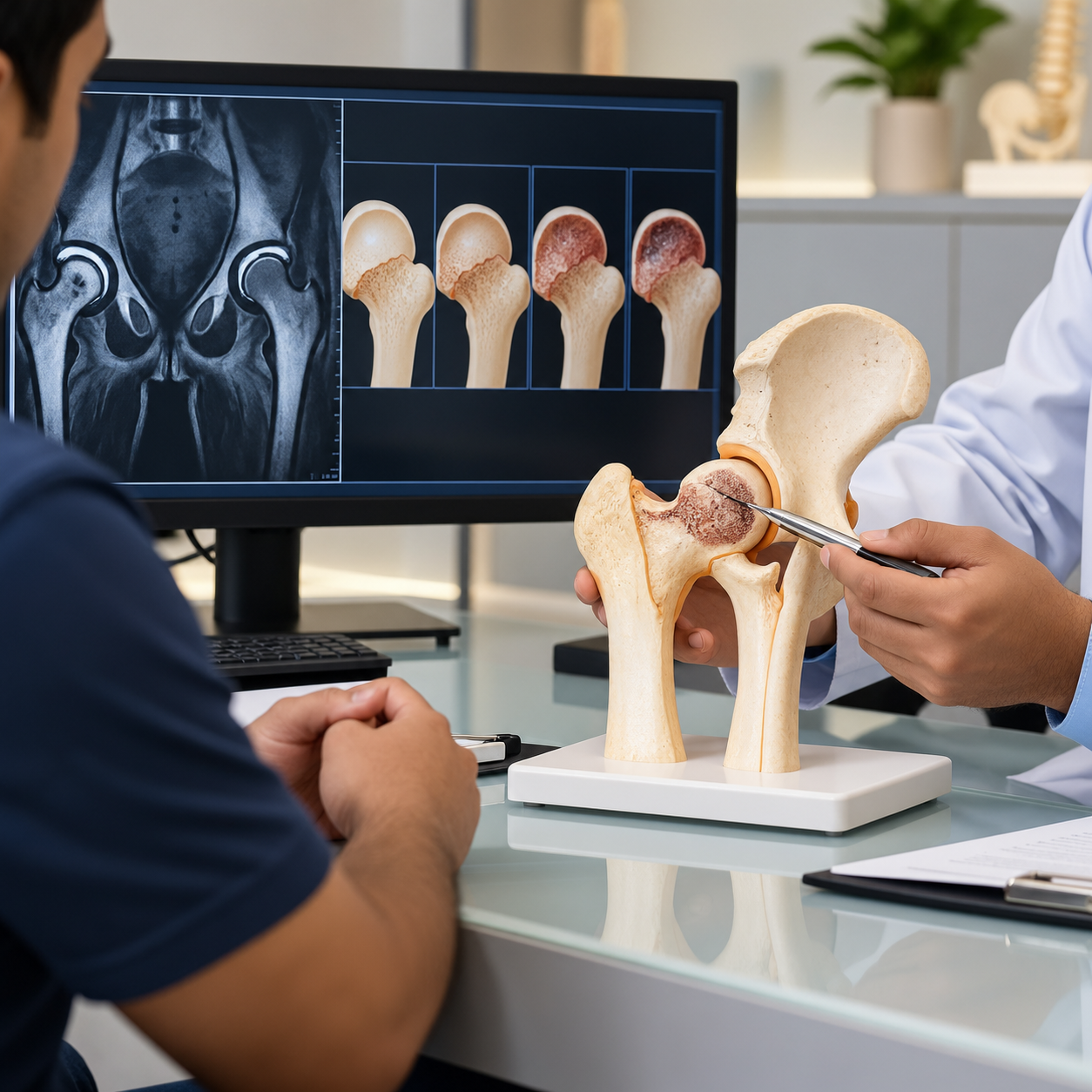
Avascular necrosis of the hip develops when blood supply to part of the femoral head becomes compromised. Without adequate circulation, bone tissue can weaken. If the condition progresses, the rounded femoral head may lose its normal shape, eventually affecting the hip-joint surface. AVN of Hip Joint Treatment therefore depends heavily on how early the condition is identified.
For patients in Thane, Maharashtra, persistent groin pain plus unexplained hip discomfort can justify orthopaedic assessment, particularly when recognised risk factors are present.
Symptoms Can Be Subtle Initially
Early AVN may produce little discomfort. As the condition progresses, pain can become more noticeable.
Symptoms may include:
- Groin pain
- Hip pain during walking
- Pain while standing
- Reduced hip movement
- Limping
- Increasing difficulty with stairs
- Pain during routine activity
- Reduced walking tolerance
Symptoms can sometimes occur in both hips, even when one side feels worse.
Why Early Imaging Matters
Plain X-rays are useful for assessing established structural changes, but early AVN may not always be obvious on routine radiographs.
MRI can identify changes at an earlier stage in appropriate clinical situations.
Staging is important because treatment possibilities differ considerably before plus after collapse of the femoral head.
Treatment Planning Before Collapse
In earlier stages, the objective may be to preserve the natural femoral head where clinically feasible.
Management depends on lesion size, location, symptoms, stage, patient factors.
Non-surgical strategies may include modification of loading, management of relevant underlying risk factors, clinical monitoring.
Selected patients may be considered for joint-preserving procedures such as core decompression. Surgical planning depends on the specific characteristics of the lesion.
No single procedure is appropriate for every early AVN case.
What Changes After Structural Collapse
Once the femoral head has significantly collapsed plus secondary arthritis develops, joint-preserving options may become less predictable.
Patients with advanced painful disease plus substantial functional limitation may be evaluated for hip replacement.
This difference explains why staging is central to AVN management.
The treatment question is not simply, Does the patient have AVN? It is, What stage is present, how much of the femoral head is affected, has collapse occurred?
What to Discuss During Consultation
Patients can ask about:
- Current AVN stage
- Extent of femoral-head involvement
- Evidence of collapse
- Condition of the joint surface
- Possibility of joint preservation
- Expected progression
- Activity recommendations
- Surgical indications
- Rehabilitation requirements
Previous X-rays plus MRI scans should be brought to the consultation whenever available.
Choosing Care According to Disease Stage
At About The Bone and Joints - Advance Ortho Care in Thane, evaluation of hip AVN can focus on disease stage plus the feasibility of preserving the natural joint.
Patients across Thane plus Maharashtra should avoid delaying assessment solely because pain remains manageable. Symptom intensity does not always reveal the complete extent of structural change.
AVN of Hip Joint Treatment can range from observation plus risk-factor management to joint-preserving surgery, eventually joint replacement in advanced cases. A stage-specific treatment plan gives patients a clearer understanding of what can realistically be achieved at their current point in the disease process.
Keywords