A congenital bony bridge between the radius and ulna can leave the elbow and wrist moving normally while blocking the forearm’s ability to turn the palm up or down. By understanding the movement loss, the compensations it causes, and how clinicians assess function, you can recognise which limitations matter and what treatment decisions involve.
Key takeaways
- A bony bridge fixes the radius and ulna, restricting palm-up and palm-down rotation.
- Turning keys, opening jars, and using utensils can become difficult.
- Children often adapt early; adults may notice problems during work or injury recovery.
- X-rays confirm the fusion; surgery is considered when limitation disrupts daily function.
How the fused radius and ulna block forearm rotation
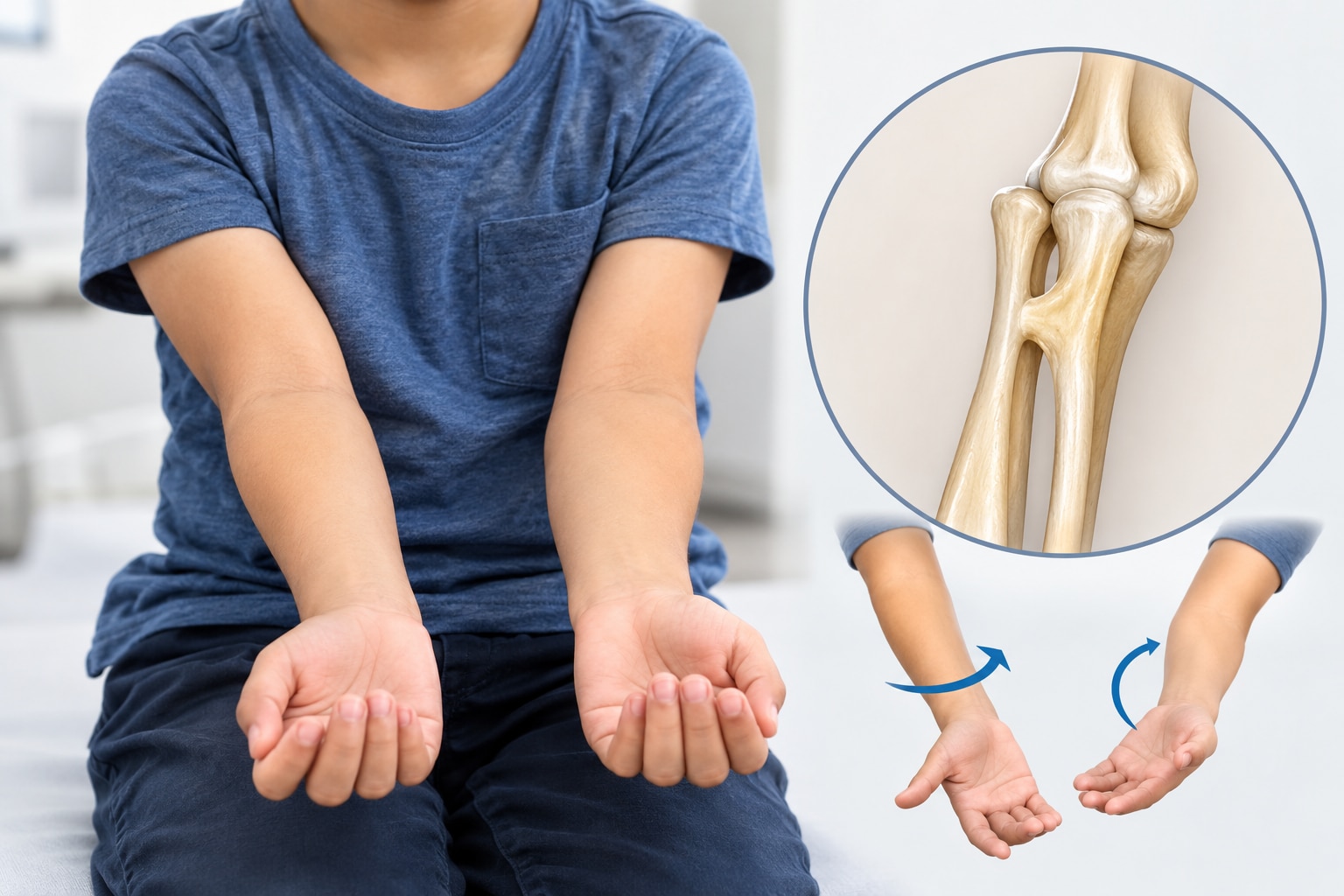
Congenital radioulnar synostosis occurs when the radius and ulna fail to separate normally during limb development. A bony bridge, usually near the upper forearm, creates a fused radius and ulna. This abnormal connection fixes the two bones in one relationship instead of allowing the radius to rotate around the ulna.
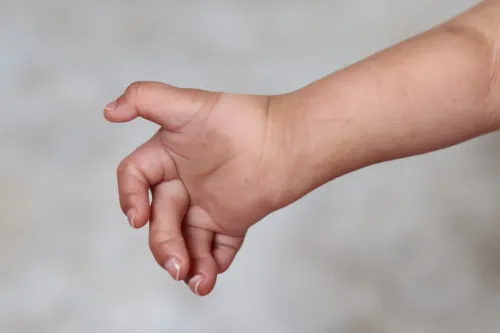
That is why forearm rotation is restricted. Pronation turns the palm down, while supination turns it up; both depend on coordinated movement between the radius and ulna. The fused segment acts like a rigid brace, so the palm may remain partly face-down and have little ability to reach a palm-up position.
Supination is often the more limited direction.
Elbow and wrist motion can remain usable because they rely on different joints. You may still bend and straighten the elbow, and flex or extend the wrist, while the forearm itself cannot twist. The hand therefore moves through the available wrist and elbow range but does not fully change its facing direction.
A person can have little pain and near-normal-looking joint movement yet struggle to position the palm for tasks requiring rotation.
Which everyday movements become difficult
A fixed palm-down position makes tasks requiring the palm to face upward or sideways awkward, even when elbow bending and wrist movement remain usable. With a limited palm-up reach, you may rotate your shoulder or tilt your trunk instead of rotating the forearm.
| Task | What becomes difficult | Typical compensation |
|---|---|---|
| Turning a key | Aligning the key and applying force without rotating the forearm | Move the shoulder, wrist, or whole body |
| Using a spoon | Keeping the bowl facing upward while bringing it to the mouth | Tilt the wrist or use the opposite hand |
| Receiving change | Holding the palm open to accept coins | Cup the hand or ask for coins on a surface |
| Washing | Reaching the opposite side of the body or washing the face comfortably | Turn the shoulder, elbow, or torso |
| Typing and writing | Positioning the hand over a keyboard or writing on a slanted surface | Shift the paper, keyboard, or wrist angle |
| Tools and sports equipment | Repositioning a screwdriver, racquet, bat, or club quickly | Change grip, stance, or shoulder position |
One-sided limitation can be surprisingly manageable because these adjustments become automatic. Marked limitation in both arms leaves fewer alternatives, making dressing, personal care, tool handling, and sports practice more tiring or slower. A palm-up correction can improve spoon use and receiving change but make palm-down tasks harder.
When children and adults notice the limitation
A child may show childhood signs when writing, dressing, or reaching for objects requires a palm-up position. In a one-sided case, the other arm can handle tasks that need rotation, while shoulder compensation, wrist positioning, or altered grasping hides a large measured loss. Pain is not necessary for the limitation to matter.
Bilateral radioulnar synostosis removes that easy workaround, although the two arms can differ in position and severity. Children may rotate the whole upper limb from the shoulder, tilt the trunk, or angle the wrist; these movements make the hand useful but do not restore forearm rotation.
The difference becomes clearer when tasks demand speed, precision, or both hands.
- School: handwriting, ruler use, turning pages, and desk work become slower when the hand cannot settle on the needed angle.
- Work: tools, keyboards, laboratory equipment, driving controls, or repetitive handling can expose the fixed position.
- Self-care: washing, eating, fastening clothes, and receiving or passing objects may require extra body movement.
- Sport: gripping a bat, racket, handle, or ball can be awkward because the shoulder and trunk substitute for forearm rotation.
Adults often notice the limitation after a new job, sport, or injury increases these demands. A painless arm can still fatigue from repeated compensation.
How clinicians confirm the movement loss and rule out other causes
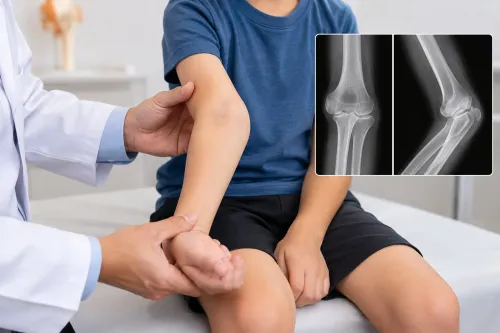
A lifelong, painless loss of pronation and supination with childhood-onset restricted rotation points toward congenital radioulnar synostosis. With the elbow at the side, test palm-up and palm-down movement while separately checking elbow bending and wrist motion; compare with the opposite arm.
Congenital cases often show a fixed forearm position but preserved elbow and wrist flexion and extension.
- Healed fracture: ask about a forearm or elbow fracture, casting, and the date rotation became limited. Tenderness, angulation, scars, or a change after healing supports an acquired cause.
- Traumatic radioulnar synostosis: look for prior elbow trauma, surgery, burns, infection, or prolonged swelling before the restriction began. A previously normal range followed by progressive stiffness is not a congenital pattern.
- Radial head dislocation: inspect the elbow contour and feel for an unusually prominent radial head; pain, clicking, or limited elbow movement adds suspicion.
- Abnormal radial head development: a small or misshapen radial head, altered forearm shape, or unequal forearm length suggests associated skeletal development rather than an isolated fusion.
- Nerve or muscle disease: weakness, wasting, sensory change, abnormal reflexes, or a difference between active and passive movement points away from a fixed bony block.
Radiographs confirm the suspected anatomy when examination cannot separate these causes.
What X-rays show—and when other tests are useful
Plain forearm radiographs usually show the fused segment, its position, and the abnormal relationship between the radius and ulna. They can also reveal a hypoplastic or dislocated radial head, abnormal radial bowing, or differences in forearm length and shape. The visible bridge is only part of the deformity.
- CT before surgery defines the three-dimensional bony anatomy, including the bridge’s extent and nearby joint shape, when radiographs do not provide enough detail.
- MRI is useful when pain, soft-tissue disease, cartilage problems, or another diagnosis needs investigation; it is not routinely needed for an uncomplicated bony synostosis.
- Nerve-conduction testing helps assess suspected nerve disease when weakness, numbness, or muscle wasting does not fit a fixed mechanical restriction.
- Genetic assessment is considered when both forearms are affected, other skeletal differences are present, or the family history suggests an inherited condition.
- Elbow or wrist imaging identifies associated joint abnormalities and checks whether those joints contribute to the limited hand position.
A radiographic fusion alone does not indicate surgery. Clinicians combine the image with movement, hand position, function, symptoms, and developmental history. They also check for an acquired bridge after fracture, trauma, surgery, burns, infection, or heterotopic ossification because its cause changes prognosis and treatment.
When observation or corrective surgery makes sense
Observation makes sense when the hand reaches useful positions, daily tasks remain manageable, and shoulder, wrist, or trunk compensation does not cause fatigue or pain. A fused forearm in moderate supination may be more useful than an operation that improves palm-up reach but makes palm-down tasks harder.
Clinicians match treatment to the actual deficit, not the X-ray or rotation measurement alone. They consider:
- Fixed hand position and severity of functional restriction
- Age, bone size, growth, and the child’s school or self-care demands
- Work, tools, sport, and the need for speed or precision
- Whether the opposite arm is normal, affected, or already overloaded
- Whether compensation remains effective during two-handed tasks
For severe limitation, a derotational osteotomy cuts and repositions the fused forearm into a more useful orientation. Timing is individualised; early surgery is not automatically better, and operating only to improve appearance is not justified.
In bilateral cases, bilateral correction may place each arm at a different angle, preserving access to both palm-up and palm-down functions.
The trade-off is permanent repositioning, not restored normal rotation. Risks include nerve or vascular injury, compartment syndrome, nonunion, malunion, loss of correction, and recurrent or progressive deformity. About The Bone & Joints - Advance Ortho Care can help coordinate an assessment that documents these functional trade-offs before surgery is considered.
Frequently asked questions
How does congenital radioulnar synostosis block forearm rotation?
A bony bridge joins the radius and ulna, preventing the radius from rotating around the ulna.
Which everyday movements become difficult?
Palm-up and palm-down movements can hinder turning keys, opening jars, using tools, and handling utensils.
When do children and adults notice the limitation?
Children may adapt without recognising the difference, while adults may notice it during work, sports, or recovery from an injury.
How do clinicians confirm movement loss and rule out other causes?
They compare both forearms, measure pronation and supination, assess the elbow and wrist, and review the history and imaging.
What do X-rays show in congenital radioulnar synostosis?
X-rays show the location and extent of the bony bridge, bone alignment, and related changes in the radius or ulna.