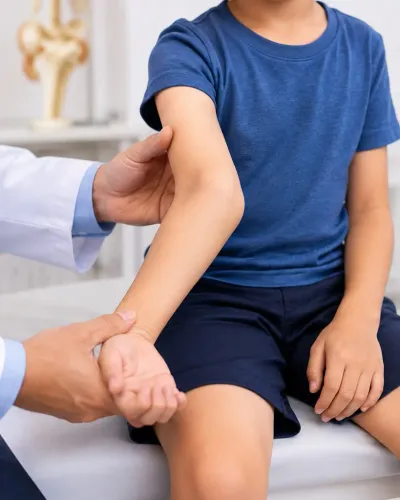
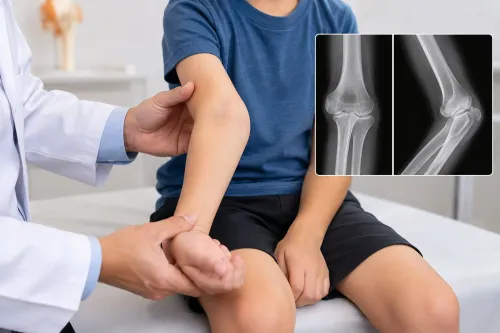
Knee pain associated with valgus alignment can place increased stress on the outer portion of the joint. When this mechanical pattern contributes to compartment-specific cartilage damage, Distal Femoral Osteotomy may be considered in selected patients.
This joint-preserving operation changes alignment through the lower part of the femur. The objective is to redistribute load more favourably across the knee while preserving the natural joint surfaces that remain healthy.
Patients in Thane, Maharashtra, experiencing progressive knee discomfort with visible alignment changes may benefit from a detailed orthopaedic assessment to identify whether biomechanics are contributing to their symptoms.
Understanding Valgus Alignment
Valgus alignment is commonly described as a knock-knee pattern. The knees angle inward relative to the hip plus ankle.
A mild degree of valgus alignment may not cause problems. More substantial malalignment can increase loading through the lateral knee compartment.
Over time, excessive compartment loading may contribute to:
- Localised joint pain
- Cartilage deterioration
- Activity-related swelling
- Reduced exercise tolerance
- Difficulty walking longer distances
- Progressive functional limitation
The appearance of the legs alone does not determine whether surgery is needed.
Why the Femur May Need Correction
Lower-limb alignment can originate from different anatomical locations. In some patients, the main deformity comes from the femur rather than the tibia.
Corrective surgery needs to address the actual site of deformity. Distal Femoral Osteotomy is therefore planned using detailed measurements rather than simply correcting the knee based on appearance.
Standing alignment radiographs can help identify where the deformity originates plus how weight-bearing forces pass through the limb.
Evaluation Before Considering Surgery
An orthopaedic assessment may review several factors:
- Patient age
- Activity level
- Pain location
- Degree of valgus alignment
- Cartilage condition
- Ligament stability
- Knee movement
- Previous surgery
- Previous fractures
- Functional expectations
Advanced imaging may sometimes be considered when additional information about cartilage, menisci, ligaments is needed.
The goal is to determine whether alignment correction addresses the principal cause of symptoms.
What the Procedure Aims to Achieve
During the operation, the femur is carefully cut at a planned location. The correction is created according to preoperative measurements, then stabilised using suitable fixation.
The objective is not merely cosmetic straightening. The important aim is mechanical load redistribution.
This distinction matters because surgical planning is based on joint preservation plus biomechanics.
Rehabilitation Requires Patience
Bone must heal following an osteotomy. Rehabilitation therefore differs from recovery after minor arthroscopic procedures.
Patients may initially require walking support. Progression of weight-bearing depends on surgical technique, fixation stability, radiographic healing, surgeon guidance.
Physiotherapy generally works toward:
- Restoring knee movement
- Maintaining muscle activation
- Improving strength
- Rebuilding walking confidence
- Progressing functional activity
Return to demanding exercise should follow clinical assessment rather than a fixed timetable.
When Specialist Assessment Becomes Useful
Persistent pain along the outer knee, increasing valgus deformity, recurrent swelling, declining activity tolerance can justify further evaluation.
At About The Bone and Joints - Advance Ortho Care in Thane, assessment can help establish whether symptoms arise from alignment-related compartment loading, cartilage disease, ligament problems, another knee condition.
Distal Femoral Osteotomy is not a routine solution for every valgus knee. Its value lies in carefully selected cases where the location of deformity plus the pattern of joint damage make mechanical correction appropriate.
A structured assessment provides patients across Thane plus Maharashtra with clearer information about whether joint preservation remains realistic before more extensive reconstruction is considered.
Keywords